
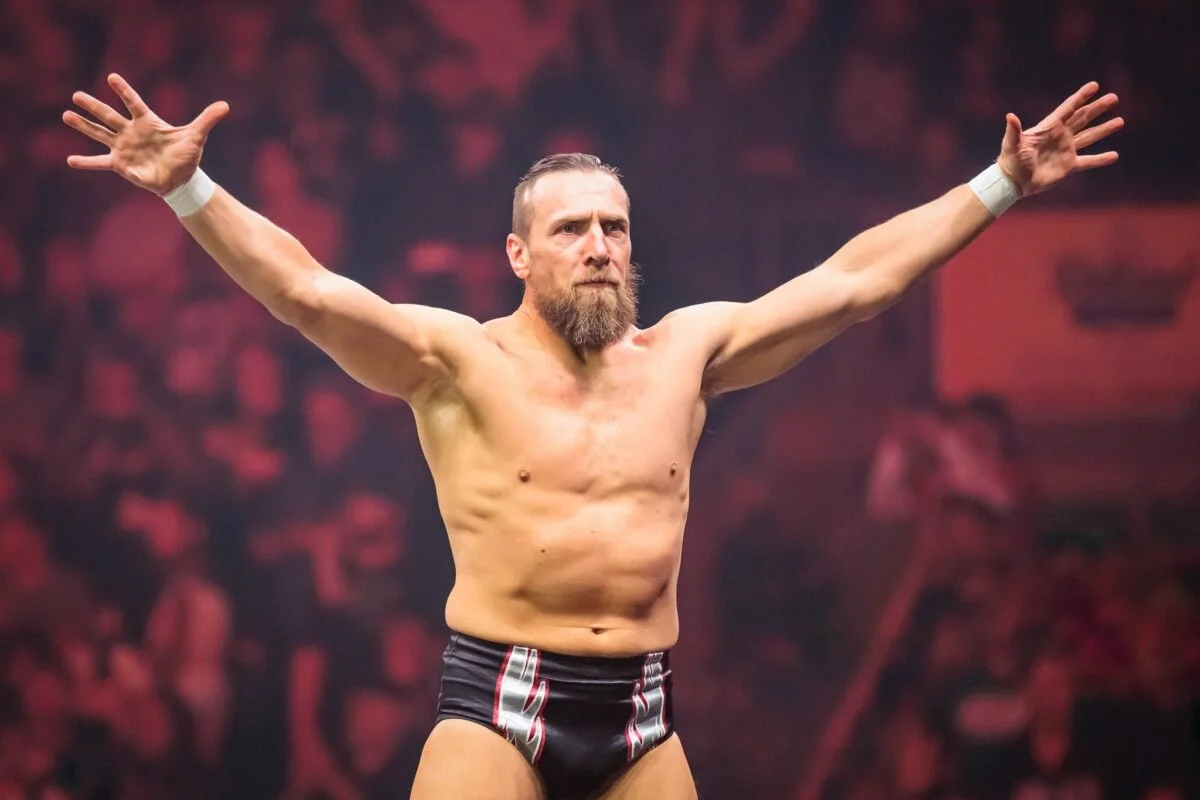
Bryan Danielson, renowned wrestler and locker room leader in All Elite Wrestling (AEW), asserts that AEW’s emergence has compelled WWE to increase the pay for its athletes. Since leaving WWE in 2021 after his last match for the company, Danielson transitioned to AEW, where he has become one of its most respected stars. He recently spoke on The Kairouz Bros podcast about how AEW’s presence as a rival has altered salary dynamics in professional wrestling.
Danielson pointed out that although AEW generates considerably less revenue than WWE, it compensates its wrestlers more generously. This financial approach has pressured WWE to raise pay in order to retain talent. He highlighted the importance of AEW’s challenger status in reshaping the industry’s salary standards.
Danielson Explains the Business Realities Behind Salary Changes
In his discussion, Danielson expressed his curiosity about the mindset of WWE decision-makers given AEW’s growing success. He emphasized that AEW’s existence poses a real threat to WWE’s substantial business, prompting a rethink in compensation structures. According to Danielson, AEW pays wrestlers a larger share of its revenue compared to WWE, affecting how athletes are valued in the wrestling business.
He explained that, typically, players in major American sports receive between 40 to 50 percent of revenue. WWE had historically fallen short of this benchmark in paying its wrestlers. Although WWE still does not reach this percentage, Danielson believes it now must offer better pay to prevent talent from moving to AEW, which does meet these standards despite earning less overall.
“I’m just curious, like, what the people who are making these decisions, what they’re thinking, right? In the sense of like, ‘Oh, okay, this AEW thing. It’s a real danger to our billion-dollar business.’ That can’t be it. AEW existing and being this challenger brand, and being as successful as we’ve been, has changed the landscape for wrestling, for the wrestlers themselves. Wrestlers are being paid more now than ever from a sports rights perspective. So, for example, in most major sports in the United States, the players get anywhere between 40 to 50% of the revenue. WWE was paying their wrestlers nowhere close to that. Now, keep in mind, they’re still not paying anywhere close to that, but they do have to pay more, because if they don’t, the talent is going to leave and go to AEW. AEW does pay that 40 to 50% of their revenue to their wrestlers. You know, despite making much less money. I mean, we still, our TV rights deal was incredible, but we’re, we’re still the challenger brand catching up on however many years WWE has.”
—Bryan Danielson, AEW wrestler and locker room leader
Understanding AEW’s Position as a Challenging Brand
Danielson’s insights underscore how AEW serves as a serious contender to WWE’s dominance. Although AEW earns less overall, its commitment to paying wrestlers a competitive share of revenue breaks from traditional wrestling pay models. This development threatens WWE’s talent pool, encouraging WWE to adjust its pay scales upwards as a retention strategy. The competition from AEW has thus created an evolving financial landscape in professional wrestling.
Danielson’s analysis highlights AEW’s challenge in catching up to WWE’s decades of market control, but also affirms AEW’s growing influence by changing how wrestlers are compensated. This shift represents broader changes in wrestling’s commercial framework, where athletes’ earnings are becoming more aligned with revenue generated.
Danielson Comments on The Rock’s Recent Appearance
Aside from salary discussions, Danielson also talked with Jon-Bernard Kairouz about a recent change in WWE veteran The Rock’s physique. Danielson humorously noted The Rock’s weight loss, making observations about the wrestler-turned-actor’s proportions.
“Do you know what’s funny? He’s super handsome? Do you know what he looked like to me when I saw the picture in comparison to the rest of his body? Now it looks like he has a big head! Guess what, Rock? You’re not so handsome anymore. How does it feel, I mean, he’s still obviously much more handsome than me, but how does it feel to not be as handsome as you used to be? Take that!”
—Bryan Danielson, AEW wrestler and locker room leader
Danielson added with a laugh that the head appeared unusually large compared to The Rock’s now slimmer body, joking about how fans may be unused to seeing the Rock with a less muscular frame.
“And it might just be that we never noticed because he was so jacked, he just always had this giant head!”
—Bryan Danielson, AEW wrestler and locker room leader
The Broader Impact of AEW’s Growth in Professional Wrestling
AEW’s influence, as detailed by Bryan Danielson, signifies a meaningful change within the professional wrestling industry. By compelling WWE to increase wrestler salaries, AEW is reshaping business practices that have long favored the promotion over its talent. Danielson’s perspective reveals how talent value and compensation are at the core of the evolving wrestling landscape.
This shift not only benefits current wrestlers financially but may also influence how future contracts and negotiations unfold across the industry. AEW’s competitive offers could raise the standard for wrestler pay across other promotions as well, potentially leading to a more athlete-centric approach to compensation.
As wrestling fans watch the rivalry between AEW and WWE grow, the competition over talent and salary structures remains a key storyline behind the scenes. Bryan Danielson’s remarks provide valuable insight into the underlying tensions and transformations that are shaping professional wrestling today.

