
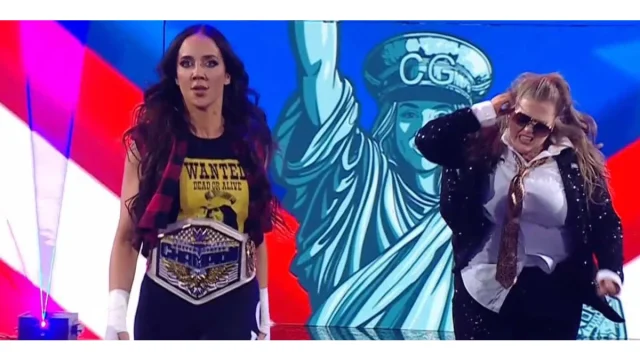
Chelsea Green, former WWE Women’s United States Champion, has addressed remarks made about her role on WWE Unreal, the Netflix documentary series. Speaking on SiriusXM’s Reality Checked with hosts Dorinda Medley and Kiki Monique, Green confronted comments from Michael Hayes, a WWE head producer, regarding her position in the company and her limited screen time.
Details of Michael Hayes’ Comments on Green’s Role
Michael Hayes, who works closely with WWE executive Triple H, described Green’s participation on WWE Unreal by saying,
“Chelsea makes the most out of her time, so we don’t need to give her 30 minutes. We give her 30 seconds, and she does the same work, which is great because she’s not meant to be here for 30 minutes. She’s not meant to be the top girl,”
according to Green’s recounting.
He further explained that Green’s role was designed to help elevate other wrestlers rather than to headline events herself, highlighting stars like Charlotte Flair and Tiffany Stratton as the intended main eventers. Hayes’ remarks suggested a ceiling on Green’s advancement within WWE’s hierarchy, a fact that she found difficult to hear.
Chelsea Green Shares Her Reaction to Being Limited in WWE
Green described the impact of Hayes’ statements, saying,
“It’s crazy because I’m a self-aware human being, so I know my kind of place on the totem pole in this fake hierarchy that is wrestling. But to actually hear it, to actually hear that there was a ceiling put on me, it’s different.”
She expressed frustration and disappointment, reflecting on the bitter reality confirmed publicly:
“You can’t help but be pissed off and a little upset and just aggravated at the fact that you thought that there was maybe a chance that there wasn’t that ceiling, that maybe it was all in your head and that it was confirmed and it wasn’t confirmed to me, it was confirmed on national television.”
Context of WWE Unreal Season Two and Its Insights
The second season of WWE Unreal on Netflix offered behind-the-scenes insight into WWE’s internal dynamics, including candid commentary from producers like Hayes. These comments shed light on how talent like Green is positioned not to lead but to support the promotion of other wrestlers earmarked for stardom.
This revelation underscores the competitive structure within WWE’s women’s division and highlights the challenges faced by wrestlers striving for top billing amid defined roles shaped by management decisions.
Implications for Chelsea Green and WWE Women’s Division
Green’s response to the “ceiling” placed on her resonates beyond her own career, reflecting broader discussions about opportunities and limitations faced by female wrestlers in WWE. As WWE continues to evolve its women’s division, this conversation may influence how talent is utilized and promoted in future seasons of WWE Unreal and beyond.
Given the public nature of these revelations, it remains to be seen how WWE will address perceptions of hierarchy or if wrestlers like Green will challenge these boundaries to attain higher status.

