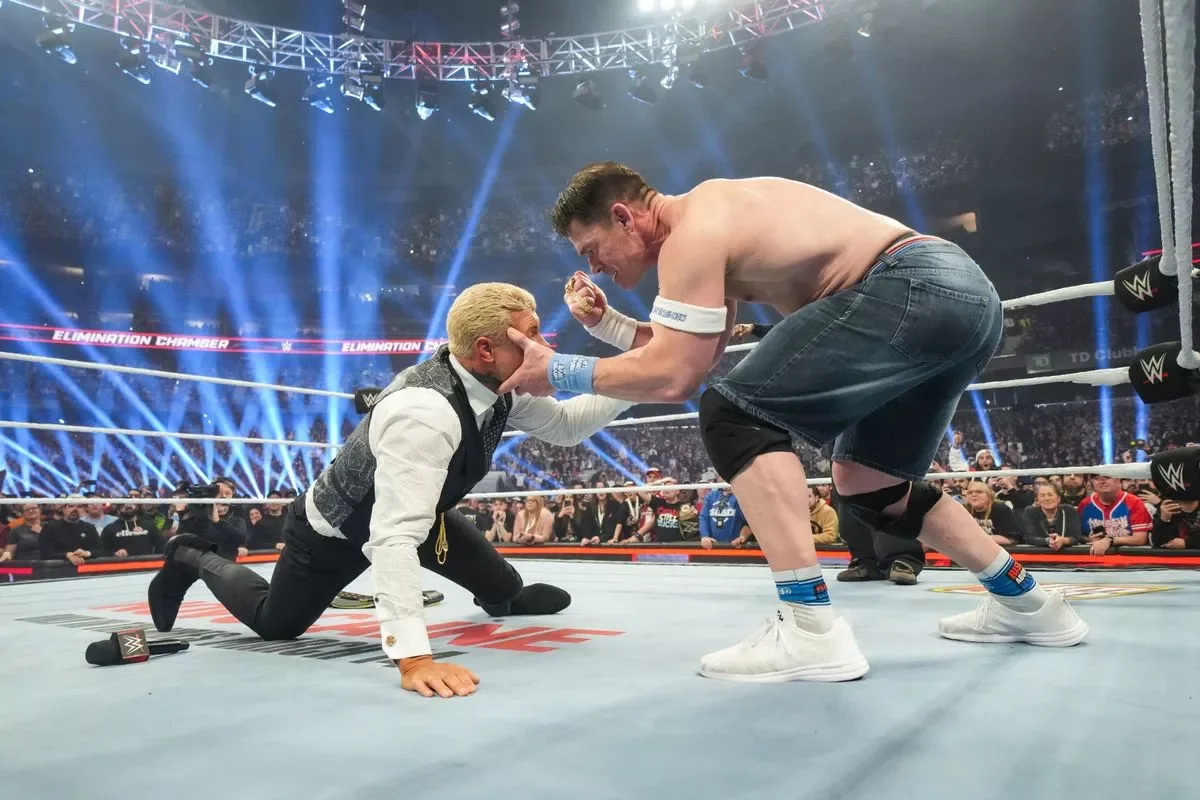
Eric Bischoff, a WWE Hall of Famer and the former president of WCW, recently analyzed what went wrong with the John Cena heel turn, sharing his candid thoughts on his podcast, 83 Weeks. This discussion provided a detailed John Cena heel turn analysis, with Bischoff highlighting areas where the narrative fell short and what could have made it more impactful.
Lack of Narrative Build-Up Diminished the Heel Turn
Eric Bischoff expressed clear disappointment with the way John Cena’s transition to a villain was managed, pointing out that the moment, while visually memorable, did not have the foundational storytelling required to fully resonate with fans. He illustrated his view by saying,
“Yeah, the heel turn was definitely a disappointment. And I think what disappointed me specifically was the lack of build-up towards that moment. Just freeze that moment with the hug and looking over the shoulder — that moment right there, that was kind of cool. I liked it. I would have freaking loved it if something would have happened along that journey to that point that would have at least nurtured my interest in seeing something happen.”
—Eric Bischoff, WWE Hall of Famer
Missed Opportunities for Subtle Character Evolution
Bischoff detailed what he believed could have set the change apart, wishing the creative direction had played with subtle signs that hinted at a new attitude in Cena without immediately giving away the twist. According to him, these opportunities would have been ideal spots for announcers and the production team to add intrigue and tension. As Bischoff reflected,
“I want to sense something’s different, but I don’t want to know what it is. I just want to feel something that’s noticeable. It could have been the way John started walking to the ring. It could have been any number of little things that the announcers could have built on. It could have helped create the story a little bit about just something so subtle that — not to the point where you’re tipping your hand, and that’s where the art comes in. This is not a science, not a math formula. You just gotta have to kind of feel it. But if they could have found that line and built up to that on top of that killer moment? Maybe things would have ultimately been different. I just think the whole thing from the get-go, for something that big, for there not to have been a better act one? To this day, confuses me. Because they have the people there to do it. They know what they’re doing.”
—Eric Bischoff, WWE Hall of Famer
Randy Orton’s Retirement Tour: A Performer Deserving Recognition
Shifting the discussion, Bischoff commented on future directions he hopes to see in wrestling entertainment, specifically mentioning his desire for a memorable retirement tour for a major WWE star. He emphasized Randy Orton’s enduring presence and skill in the wrestling ring. In his words,
Image of: John Cena
“For me, the one retirement tour that I want to see is Randy Orton. I think so much of Randy as a performer. He is such an unbelievable performer that I’d like to see him get the send-off that he absolutely deserves.”
—Eric Bischoff, WWE Hall of Famer
Impact of Storytelling Choices and What Lies Ahead
The perspective provided by Eric Bischoff points to the importance of strong narrative planning in wrestling, especially for high-profile turns such as John Cena’s. While the storyline featured standout moments, the absence of subtle buildup prevented it from achieving an even greater level of audience connection. Bischoff’s remarks underline the significance of pacing, character nuance, and the creativity of announcers in making such transitions memorable. Fans and industry professionals alike may view these critiques as lessons for future creative decisions, whether in WWE, WCW, or beyond.
Steven Monroe is a journalist at CynicalTimes.org, covering the fast-paced world of WWE.
With two years of experience, he reports on match results, superstar rivalries, and behind-the-scenes developments across Raw, SmackDown, and NXT.
Steven delivers timely, detailed coverage that keeps wrestling fans informed and engaged with the ever-evolving world of sports entertainment.
His work combines accuracy, storytelling, and a deep understanding of professional wrestling culture.