
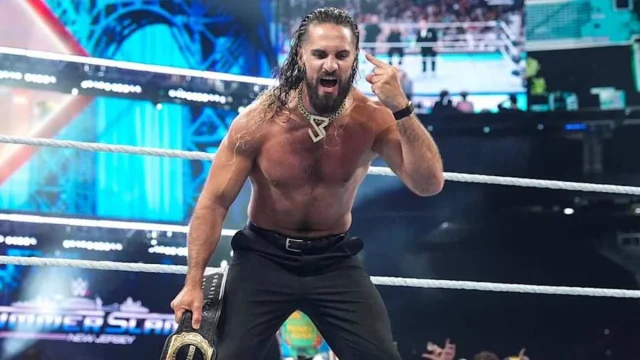
Seth Rollins has spoken out about Vince McMahon’s decision to ban his signature finishing move, the Curb Stomp, shortly after he won the WWE Championship at WrestleMania 31 in 2015. This unexpected change occurred soon after Rollins captured his first world title by cashing in Money In The Bank during the main event match between Roman Reigns and Brock Lesnar, marking a pivotal moment in his career.
Timeline and Details Behind the Move Ban
Rollins used the Curb Stomp to secure the championship victory, a move he had developed and refined over the years, gaining significant recognition among fans. However, the night after WrestleMania, WWE suddenly prohibited the use of the Stomp. Forced to adapt quickly, Rollins shifted to employing the Pedigree as his new finishing maneuver. He shared his experience with Complex News, describing the decision as abrupt and without any warning.
Rollins Describes the Unexpected Decision
He recalled the moment vividly:
“It sucked because I was given no heads up, and it was right after I won the World Title for the first time with that move that I’d been using for years as a finish, and it had built up a ton of equity.”
Rollins explained that the move was banned because WWE was concerned about its perceived danger, especially with younger viewers potentially trying to imitate it at home. Despite Rollins emphasizing his own safety and control when performing the Stomp, the company deemed it too risky.
“Then all of a sudden ‘so I don’t think we’re gonna use that anymore’. What the- ‘It’s too dangerous, and I know you’re not dangerous, you’re very safe, but kids can do it too easily at home’. I don’t know what happened, somebody got in his ear and said it was somehow a problem,”
Rollins said.
He went on to point out the broader risks associated with wrestling moves:
“I’m like dude, it’s wrestling, if any kid imitates any wrestling move they’re gonna hurt; (Becky’s) Armbar, if someone puts an Armbar on they’re gonna snap a shoulder off. The Rock Bottom, all of it, a punch to the nose, if you don’t know how to do it, of course it’s gonna hurt somebody.”
Adjustment Period and Finding a New Finisher
Rollins detailed the rapid sequence of events, stating the ban came just a day after WrestleMania’s main event:
“I thought it was so silly but whatever, it’s not my sandbox, but it was on a whim. Like literally I did the move Sunday, won the title, beat Roman Reigns and Brock Lesnar, then fly to New York from San Francisco, do the Today Show, pet a couple dogs, say hi to Katie and Matt, fly back to Santa Clara to do Raw, and I go and Vince is like ‘I gotta talk to you about something, we’re not gonna do that anymore’.”
When asked about alternative finishers, Rollins rejected the idea of adopting a Frog Splash, citing concern for his long-term health:
“They wanted me to do like a Frog Splash, and I’m like absolutely not, I’m not doing that every single night. I like my knees, I like my elbows, it’s not happening.”
With guidance from Triple H, who was mentoring him at the time, Rollins settled on the Pedigree, a move previously associated with Triple H but unused as a finisher in recent years. Rollins described this choice as practical despite some reservations.
“He was hesitant about it too, he didn’t like it, I think he really hates it now because people kick out of it sometimes, I fully diluted it, but it worked for the time being, it got the desired reaction, it already had the 20 years of equity to it, which is the hardest thing to do with a finisher. Anything can be a finisher, you just have to beat people with it for a while.” – Seth Rollins, WWE Superstar
Current Status and the Path Forward
Currently, Seth Rollins is sidelined due to a shoulder injury sustained at WWE Crown Jewel in Perth in October. Despite this setback, his legacy remains defined by his adaptability and in-ring talent. The ban on the Stomp represents a significant episode illustrating the challenges performers face balancing creative identity with workplace safety rules in WWE.
Rollins’ experience also highlights broader considerations within professional wrestling as promotions navigate the complexities of protecting talent and audiences from dangerous imitations, whilst preserving the unique appeal of performers’ signature moves. Fans and industry observers await Rollins’ eventual return and what innovations he might bring next to his in-ring style.

