
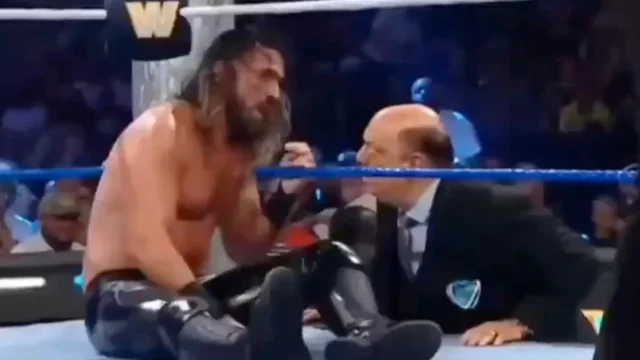
During a recent appearance on the podcast Club Shay Shay, WWE Superstar Seth Rollins discussed the injury protocol wrestlers must follow when hurt mid-match, highlighting differences compared to other professional sports. Drawing from his own shoulder injury last year during a pay-per-view event in Perth, Australia, Rollins described how wrestlers perform a rapid self-assessment to decide whether to continue, unlike the NFL where players have more time for evaluation.
He recounted an incident where he executed an unfamiliar move, diving across the ring and landing awkwardly on his elbow and shoulder. Although the area hurt immediately, Rollins wasn’t certain about the severity, so he pressed on while internally checking his condition amid the live audience and instant replays playing.
“When we get hurt, there’s like a self evaluation process that happens… We have to evaluate kind of in real time. Like we have to, it’s not a sprint like that [NFL]. It’s a bit longer so like if something happens, you know, my shoulder is a great example and all that. So I am wrestling Cody Rhodes in a main event of a pay-per-view in Perth Australia in October. I do this move that I have never really done where I dive from one side of the ring to the other and give Cody a headbutt.And I land funky. So I land kind of on my elbow and off to the side, pushes my shoulder up. And it hurt. But I didn’t know how bad it was hurt in the moment. So I hit him, I cover, he kicks out, I land in there and then I just run my self-check. While the audience is kinda, they’re going to the replays and everything,”
– Seth Rollins, WWE Superstar
Explaining the Severity of Concussion Protocols During Live Matches
Rollins also addressed a more urgent aspect of WWE’s injury protocol related to concussions, citing a recent injury involving Je’Von Evans on Monday Night RAW. Unlike the self-assessment wrestlers conduct for general injuries, concussions are treated with immediate intervention, where referees play a critical role in stopping matches quickly once a concussion is suspected or visibly occurs.
He gave a specific example of Evans’ incident to illustrate how the system worked under pressure, with referees promptly ending the contest to prioritize safety. Fortunately, Evans was later cleared of any serious head trauma, underscoring the precautions WWE has adopted in recent years.
“Now there’s sometimes where it’s like you will get a concussion, or you will see somebody get a concussion… The ref sees that happen and that’s it. It’s done. Like they just call the match off. Young fella named Je’Von Evans just had this happen to him like maybe two weeks ago on Monday Night RAW.”
– Seth Rollins, WWE Superstar
Contextual Differences Between WWE and Other Sports in Injury Management
Rollins’ comparison between WWE and the NFL highlights how differing formats dictate injury response timings. While NFL players receive immediate and extended evaluations during play stoppages, professional wrestling demands quicker, often real-time self-assessment due to the continuous flow and predetermined nature of performances. This places an extra physical and mental burden on wrestlers, who must balance performance with health risks on the spot.
The role of referees also changes significantly depending on the injury type; while concussions trigger instant stoppages, other injuries rely largely on the wrestler’s capacity to assess and communicate pain during matches. The evolving protocols signify WWE’s increasing awareness of the dangers wrestlers face in the ring and the growing emphasis on their long-term wellbeing.
Implications for Wrestlers and WWE’s Future Safety Measures
The details provided by Seth Rollins reveal a complex, demanding injury protocol that mixes self-evaluation, referee oversight, and immediate response tailored to injury severity. This system’s efficiency could profoundly affect wrestler safety, audience experience, and the overall integrity of WWE events.
As concussion awareness increases globally, WWE’s approach to handling such injuries promptly sets a precedent for improved health standards in sports entertainment. Wrestlers like Rollins and Evans demonstrate the physical risks involved, and their experiences may push WWE to refine and possibly expand these protocols to better protect performers in the future.
Fans and industry observers alike may expect ongoing discussions about injury management to influence operational changes, with potential benefits including safer working environments and longer careers for athletes within WWE.

