
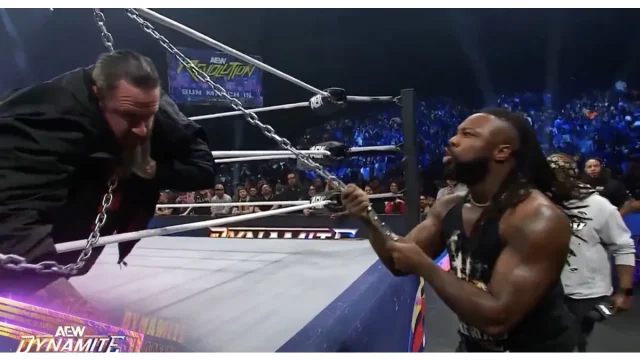
During his tenure in WWE NXT, Swerve Strickland expressed frustration over the lack of clear creative direction, specifically citing difficulties in obtaining straightforward answers from WWE executive Triple H regarding his character development. The AEW star shared these insights recently on the Kings of the Ring podcast, revealing how Stephanie McMahon’s recognition of him as her favorite villain initiated the formation of the Hit Row faction. This endorsement led WWE to back the group, although Strickland himself felt unprepared to lead a stable due to his independent wrestling background and constant travel.
Swerve Strickland Shares Background on His Music Journey While Balancing Military and Wrestling Life
Strickland detailed the origins of his rap career, tracing it back to long drives between Richmond, Virginia, and Pennsylvania for military weekend drills, coinciding with the birth of his daughter. During these trips, he immersed himself in music, memorizing songs across genres without initially realizing he was honing his rapping skills. His collaboration with artist Monteasy, starting in 2015 and expanding after moving to Florida in 2017, deepened his exposure to music production. Despite early challenges during the COVID-19 pandemic, Strickland persisted, releasing records like those from the BrokeBois collective, and gradually treating music with the same dedication he applied to wrestling.
Reflections on Wrestling as an Art Form and Career Choice
Strickland described professional wrestling as an art form that fueled his passion, despite its challenges and unpredictability. He emphasized that wrestling did not begin as a straightforward career choice but rather as something he pursued despite obstacles and setbacks. Strickland explained,
“I didn’t expect it to be a career choice. It was an art form to take on pretty much. It’s just like taking on music. Never really think of it as this is going to be…. [For] some people, it’s like, ‘This is my way out, this is my way to get out of this bad situation.’ A lot of times it’s like that, but for me, it was just something I had a passion for. I always describe to people, especially fans that are coming up to me asking me about pro wrestling, ‘A passion is something that you do that doesn’t always love you back.’ So you chase it, you love it, but it’s not always treating you the best. But you still pursue it because even with all the downfalls, the hits you take, the barriers they put in front of you, something still keeps making you keep chasing and going on that path. That’s what wrestling was for me. It was just an art form that I wanted to get good at, and then it turned into a career in a sense.”
Insights into the Creation of WWE Evolve and Hit Row
Strickland recounted the complex development of WWE Evolve and the Hit Row group, noting that Evolve encountered significant delays before finally launching. His dialogues with Triple H were marked by evasiveness regarding creative details for his character. Ultimately, Stephanie McMahon’s affirmation led to the promotion backing Strickland and assembling Hit Row as a stable. Strickland acknowledged his initial unfamiliarity with managing a group due to his itinerant independent career but valued the support WWE provided the quartet. He also expressed regret that the group did not have more time to develop fully within WWE.
The birth of it was really interesting because they had their own thing going on when they were supposed to have Evolve then. That got delayed for years. I didn’t expect it to take so long for Evolve to become a thing. Triple H, me and him were just going back and forth. He was dodging me when I was coming up with creative questions and stuff. And then finally, I think it was Stephanie McMahon that really told me he was her favorite heel on the show. They were like, ‘Hey, I think we’re going to put this group behind you. How do you feel?’ I was independent, jumping from city to city, country to country. So running a group was just not my thing. I didn’t know how to. But the group became more like them backing me. Then we became a real group, like all four corners together. I just wish we had more time together with it. But you know, things happen.
Views on John Cena’s Doctor of Thuganomics Character and Its Cultural Impact
Strickland reflected on the influence of John Cena’s Doctor of Thuganomics gimmick, viewing it initially as satirical comedy before recognizing its lasting significance. He acknowledged R-Truth as a pioneer for infusing hip-hop elements into professional wrestling, crediting his collaborations with Tupac for setting early precedents. Strickland also cited Chris Jericho’s involvement with his band Fozzy as an example of crossing musical genres. Regarding Cena, Strickland emphasized the gradual evolution of the persona, from a comedic act to a genuine cultural phenomenon, culminating in commercially successful rap albums and media presence that extended over two decades.
He observed the unique nature of Cena adopting hip-hop style and imagery as part of his wrestling persona, understanding it both as homage and entertainment, which provided a pathway for future artists and wrestlers to explore similar intersections.
Strickland Affirms Originality and Parallels with Kenny Omega’s Uniqueness
Swerve Strickland strongly asserted that his wrestling style and persona are entirely original, emphasizing that he never modeled himself on others. In an interview with Rich Latta, he drew parallels between his own authenticity and that of fellow wrestling star Kenny Omega, noting that both represent unprecedented talents unlikely to be replicated. Strickland stated,
I’m authentically myself and always have been. I never marketed or modeled myself after another wrestler, and it’s hard to compare me to wrestlers in the past because there’s never been a wrestler like me in the past. All those same exact things I can say about Kenny Omega. We’ve never seen a Kenny Omega before, and most likely, we’ll never see another Kenny Omega ever again.
He also discussed his recent physical transformation, sharing the rationale for increasing his weight to maintain agility while appearing more imposing, calling it an evolution of his character. He explained,
When I came back at 240. I was like, ‘Oh, everything is just like harder to do. Getting up and getting down. It’s like that exhausts you way more than when you’re agile.
This is like 232, 233. That’s a good weight of still agile. I don’t get blown up. I still look physically imposing. And that’s mainly why I bulked up. I just wanted to look like an evolution of Swerve again.
I’ve evolved like three times a year. So everything’s another evolution to something. And going to the extreme lengths of expanding the body is another evolution of it.
Context and Potential Implications for Wrestling Creative Direction
Strickland’s criticisms of WWE’s creative handling during his NXT period underscore ongoing challenges within wrestling’s backstage management, particularly regarding open communication and creative freedom for talent. His transition to AEW highlights a broader trend of performers seeking environments that respect their autonomy and originality. The insights into his musical pursuits and physical evolutions further illustrate how wrestlers increasingly diversify their careers and personas beyond the ring.
The backing that Strickland received from key figures like Stephanie McMahon contrasts with his experience engaging directly with Triple H, reflecting possible internal disparities in WWE’s creative processes. This dynamic may influence future decisions by both talent and management on how wrestling factions and characters are developed.
As for Strickland, his continued evolution in AEW suggests a commitment to maintaining his unique brand of wrestling and creative expression, which could impact industry standards and encourage other wrestlers to assert their individuality more forcefully.

