All Elite Wrestling (AEW) found itself in the spotlight after wrestler Brody King appeared on AEW programming wearing a shirt with the politically charged slogan “Abolish ICE.” The incident sparked immediate backlash, with industry veteran Vince Russo sharply criticizing Tony Khan’s decision to permit the shirt to be shown on national television. Russo framed the situation not as a matter of free expression, but as a misstep in leadership and business strategy.
Russo Blames AEW’s Leadership for the Dispute
During a recent episode of the Vince Russo’s Brand podcast, Russo expressed frustration with how the situation was handled by AEW’s top management. He argued that Khan should have prevented the politically divisive garment from appearing on screen, emphasizing the potential harm in dividing AEW’s fanbase. Russo explained,
“Well, I think it goes back to Tony and we talk about this all the time, Al. We talk about why would you want to split your audience? Tony should have never let him wear that gear out to the ring in the first place because yeah, bro, there are going to be people that are chanting F ICE and there are going to be people that never watch AEW again.”
The Conflict Between Political Expression and Business Interests
Russo’s viewpoint stresses AEW’s goal of growing a broad and diverse audience rather than alienating viewers over political controversies. Al Snow, a wrestling figure who joined the conversation, supported Russo’s concern from a different angle by highlighting wrestling’s traditional role as a form of escapism for fans looking to avoid real-world political tensions. Snow remarked,
“I agree because wrestling, a wrestling program, entertainment should be a place of refuge to get away from the real world. It should be a place where you can go and not be inundated with those kinds of things.”
Though some fans regard wrestling as a platform for self-expression and political messaging, Snow clarified AEW’s business model revolves around appealing to as wide and varied an audience as possible. He commented,
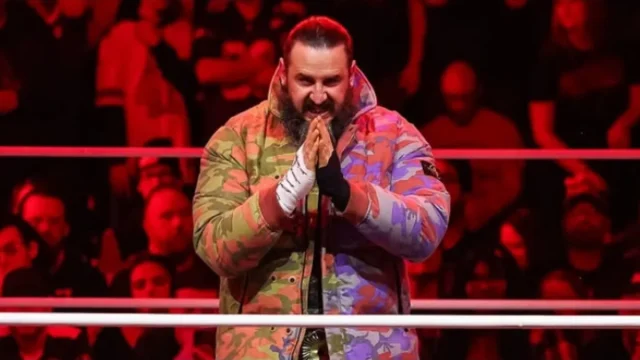
Image of: Brody King
“Now, some people will disagree and say that, well, it’s a platform and, you know, it’s a chance, but look, that’s not what Tony or AEW are in a business of appealing to a mass audience as big and as diverse and as open as possible.”
Advertiser Sensitivities Heighten the Stakes
The discussion further addressed the role of advertisers and the financial risks involved when programming becomes politically polarizing. Snow explained that advertisers aim to reach the broadest consumer base without alienating potential customers due to controversial content. He elaborated,
“And the reason they’re ultra sensitive is because the advertisers are very ultra sensitive. And if you’re in business and you just make laundry detergent, listen, you want to sell to everyone. You do not care about anyone’s views or ideas or thoughts or beliefs. You want to sell laundry detergent to the largest percentage of people that are in the population. That’s it.”
This sensitivity is tied to the risk of financial repercussions if a segment of the audience reacts negatively to the content a company sponsors. Snow detailed,
“And the second that there’s anything polarizing on any program that you are sponsoring, there’s potential that you would suffer some kind of financial backlash by simply, you know, a portion of that audience, a percentage, no matter what it is, going, you know what, we’re not going to buy your laundry detergent anymore because you sponsor these people.”
Entertainment as an Escape and the Consequences of Political Messaging
Snow pointed out that the challenge AEW faces is not new and reflects a broader advertising reality—brands carefully consider what they associate with due to potential reflections on their reputation. He said,
“That’s been since the beginning of advertising — what they associate with, what they sponsor, what they… and how it now reflects on them. And they are very, very cautious when that comes.”
Echoing the traditional role of entertainment as a sanctuary from everyday concerns, Snow continued,
“Entertainment has always been constructed as a refuge away from all of that.”
He then added,
“People resent it when they come to a movie, a television show, a sporting event, whatever, and they’re coming there to forget, to buy into, believe, enjoy whatever that event is, and then, oh wait, here’s a reminder of the real world for you. You can’t get away from it.”
Responsibility Falls on AEW Executives to Manage Political Content
The controversy surrounding Brody King’s Abolish ICE shirt was not framed as an issue of silencing wrestlers but rather holding leadership accountable for content decisions. Vince Russo was unambiguous in his critique of Tony Khan’s role, asserting that the executive should have blocked the shirt’s appearance on AEW broadcasts altogether. This incident raises a critical question for AEW’s future programming direction—whether the promotion will allow more overt personal political statements on-air or enforce stricter limits to avoid similar conflicts moving forward.
Thomas Schultz is a journalist at CynicalTimes.org, covering the AEW Men’s Division.
With one year of experience, he reports on match results, storyline developments, and the rising stars shaping All Elite Wrestling.
Thomas brings a fresh perspective and a commitment to accurate, engaging coverage of AEW’s top talent and weekly action.
His writing captures the energy, rivalries, and momentum behind one of wrestling’s fastest-growing promotions.
From major title bouts to emerging contenders, Thomas keeps fans up to date on everything happening in the AEW men’s roster.