
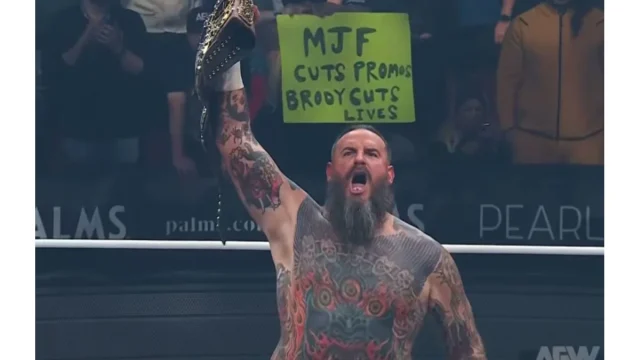
Warner Bros. Discovery (WBD) intervened to keep wrestler Brody King from appearing on a recent AEW Dynamite episode, aiming to avoid a repeat of the viral anti-ICE chant that broke out during last week’s broadcast. This move has sparked debates around Brody King AEW censorship, reflecting heightened corporate sensitivities just days before King’s AEW World Championship match in Australia.
Brody King was slated to face AEW World Champion Maxwell Jacob Friedman (MJF) at the upcoming AEW Grand Slam event in Australia. However, WBD, AEW’s minority owner and television partner, blocked King’s appearance on the show, fearing the resurgence of the politically charged “Fuck ICE” chants that gained national attention following last week’s AEW Dynamite in Las Vegas. This unprecedented absence of King from promotional broadcasts ahead of the championship contest represents a noticeable deviation from wrestling’s usual narrative buildup and signals substantial external pressures influencing creative decisions.
Corporate Pressure, Not AEW Leadership, Behind the Decision
Veteran wrestling journalist Dave Meltzer clarified that the choice to exclude Brody King was not made by AEW President Tony Khan but originated from higher corporate authority at WBD. Reporting on Wrestling Observer Radio, Meltzer explained that the company’s goal was to prevent the arena audience from chanting politically charged slogans during the broadcast.
The deal is that they didn’t want the fans in the arena to be chanting that. If Brody came out, there was that risk,
Meltzer said.
This is again not a Tony call. This is from above. Nobody wants to get on Trump’s bad side.
The timing of WBD’s interference is linked closely to its ongoing negotiations for an acquisition by Netflix, which requires regulatory approval from federal authorities under the current administration. Meltzer emphasized this fraught corporate calculus:
It’s just a chant, but, unfortunately, they’ve got a company they’re trying to sell and get regulatory approval from a guy who is gonna take that stuff personal,
he noted.
That’s just how it is. No Brody King on the show. Of course Brody King and MJF should have had a segment on the show.
This situation epitomizes the clash between creative freedom and political caution as media companies navigate the potentially punitive regulatory landscape shaped by the Trump administration, which has shown readiness to wield its power against outspoken entities.
Repeated Corporate Concessions to Political Power
WBD’s response to the anti-ICE chant controversy is not an isolated case but a symptom of a larger pattern of corporations bending to political pressure. The present administration has redefined regulatory processes, often using them as mechanisms to enforce compliance rather than as neutral legal reviews, threatening businesses that express dissenting views with possible retaliation.
The pursuit of the Netflix acquisition has placed WBD in a vulnerable position, prompting preemptive censorship to avoid antagonizing powerful political figures. This dynamic illustrates the chilling effect that fear of retribution can have on free expression within major companies, undermining the spirit of the First Amendment by promoting self-censorship as the safest course of action.
Moreover, the protests within AEW sprang from genuine anguish and activism. The “Fuck ICE” chants are rooted in real incidents, including the deaths of American citizens Renee Good and Alex Pretti during confrontations with Immigration and Customs Enforcement (ICE) and Customs and Border Protection (CBP) agents. These events occurred amid controversial mass deportations that many constitutional scholars label unconstitutional. Brody King has also demonstrated commitment beyond wrestling, notably collaborating with comic artist Daniel Warren Johnson to raise $58,000 for immigrant rights groups.
Suppression Backfires: Fan Rebellion Against Censorship
Ironically, WBD’s attempt to control the narrative is widely expected to have the opposite effect, dramatically increasing the intensity and frequency of the politically charged chanting it sought to silence. Wrestling fans, known for their passionate and defiant culture, have pledged to continue vocalizing their dissent regardless of King’s presence on AEW broadcasts.
This reaction perfectly exemplifies the Streisand Effect, where efforts to conceal or limit certain expressions only amplify them exponentially. The removal of King from the program has not quelled the chants but guaranteed they will become a recurring feature at AEW events and possibly within rival promotions such as WWE, due to audience crossover.
Wrestling audiences’ awareness of corporate censorship fuels this defiant response, transforming the chant into a broader symbol of resistance against what they view as unjust corporate capitulation to authoritarian demands.
National Political Backdrop Heightens the Stakes
The timing of WBD’s censorship coincides with a politically turbulent period, including the unfolding release of the Jeffrey Epstein documents, in which former President Donald Trump figures prominently. The administration appears to strategically generate multiple media controversies to overwhelm public attention and deflect scrutiny from these damaging revelations.
Simultaneously, the Republican Party has shown institutional support for the Trump administration’s expansive use of executive authority, prioritizing loyalty over traditional principles like free markets and limited government. This political environment intensifies the pressure on corporations like WBD to align their decisions with the administration’s preferences rather than objective standards.
Future Challenges for Brody King and AEW Amid Rising Tensions
Meltzer predicted that the conflict between fan expression and corporate control will continue to escalate.
When he comes back, it will happen again,
Meltzer remarked on Wrestling Observer Radio.
I don’t know how they’re going to handle it.
This unease highlights the problems inherent in appeasing political pressures. WBD’s attempt to silence Brody King’s message has simultaneously alienated the AEW fanbase and failed to mollify regulatory overseers, leaving the company caught between competing and uncompromising forces. King remains scheduled to compete for the AEW World Championship at Grand Slam Australia this Sunday, having gained significant popularity among AEW viewers. Whether his future television appearances will be similarly restricted remains uncertain.
Regardless of corporate attempts to manage the situation, AEW’s fanbase is determined to amplify its voice, preserving wrestling’s legacy as a platform where audience fervor and political expression intersect, irrespective of outside attempts at censorship.
This episode reflects a broader troubling trend in America where freedom of expression is not directly banned but systematically eroded through implicit threats of regulatory retaliation, compelling corporations to silence voices preemptively to avoid political repercussions. The fact that such dynamics now influence the casting of professional wrestling shows is both absurd and a stark indication of serious democratic decline.
AEW Grand Slam Australia will stream this Sunday on pay-per-view, with AEW Dynamite airing Wednesdays at 8 PM Eastern on TBS and HBO Max, and AEW Collision on Saturdays at 8 PM Eastern on TNT and HBO Max.

